
What is happening
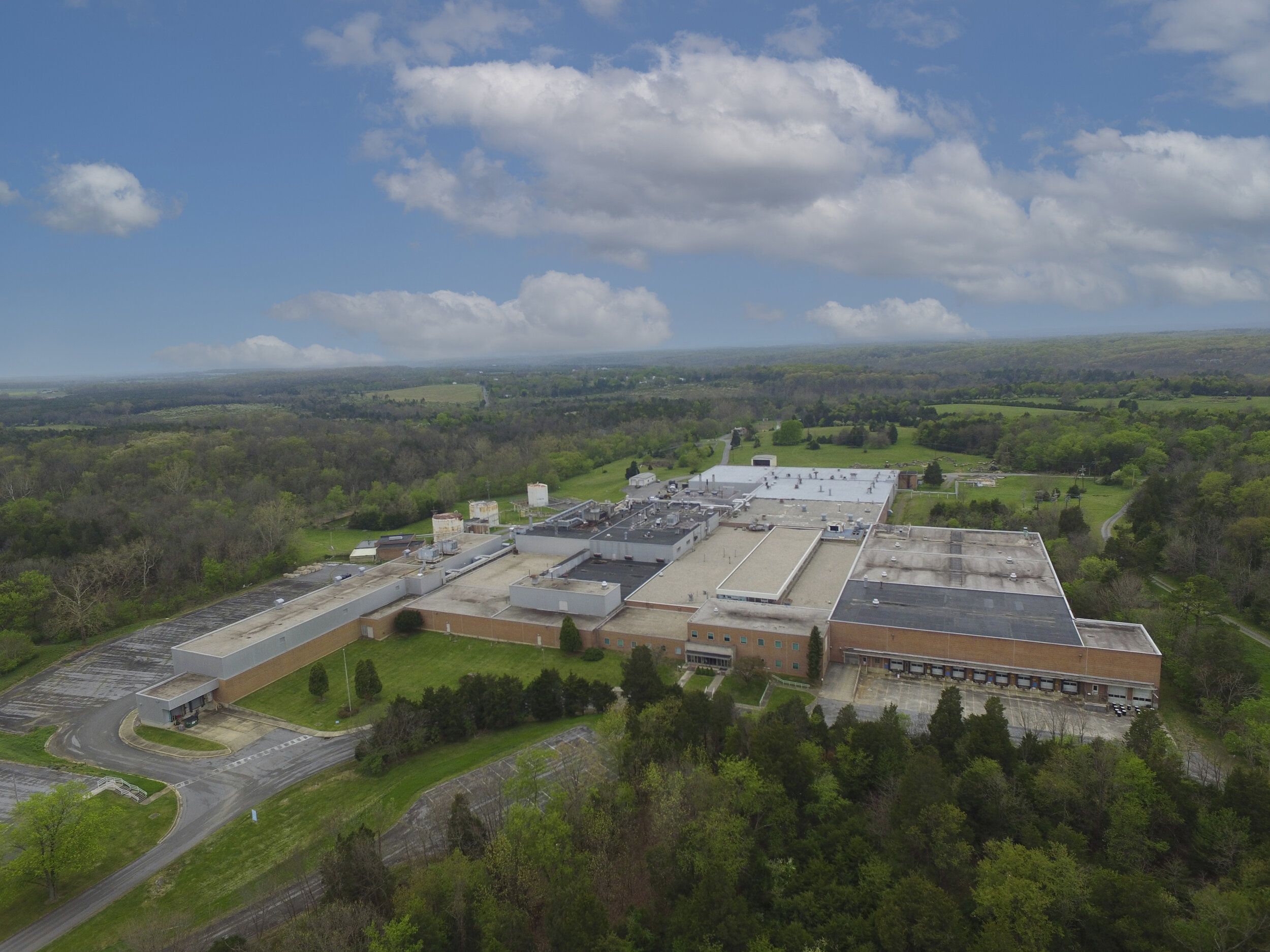
A one million-square-foot groundwater bottling facility was being proposed in Middleway at the old 3M facility. The developers submitted a concept plan to the Jefferson County Planning Commission. This is the first step in the development process.
The Planning Commission denied the concept plan twice. First, they voted unanimously in November 2024 that the application was incomplete, then they voted unanimously in March 2025 that the application did not conform to the Jefferson County Land Development and Zoning Ordinance.
The Company has sued the county claiming that the planning commission does not have the authority to determine if a project conforms to the zoning ordinance. Jefferson County Foundation and 11 affected property owners have joined as parties to the lawsuit on the side of the County (Intervened) to protect their interests and the interests of the people.
Click here for the original concept plan.
Click here for the updated concept plan. (November 18, 2024)
Click here for the further updated concept plan. (December 6, 2024)
Click here for the supplemental information.
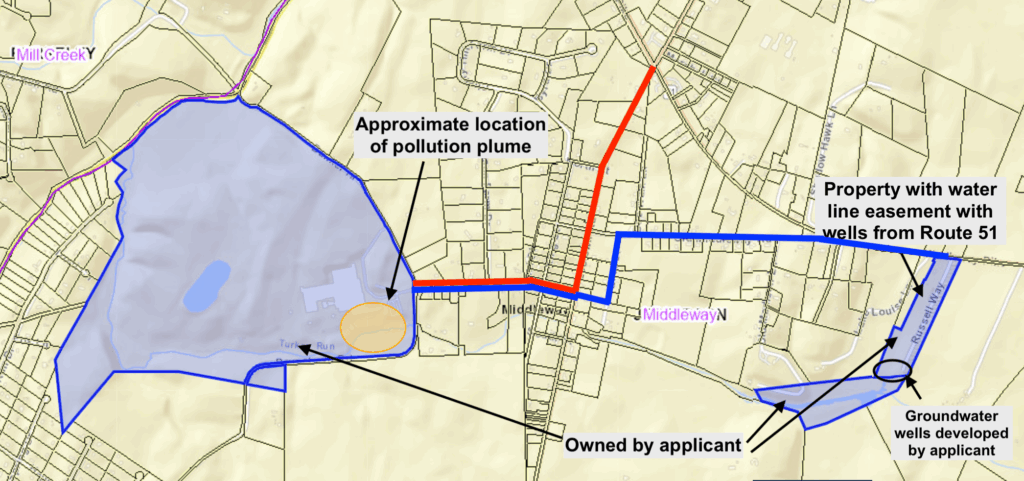
The industrial facility in Middleway, known locally as the 3M plant, was run by Eastman Kodak until 2006. The property was remediated through the voluntary remediation program between 2014 and 2019. The groundwater is contaminated with two industrial pollutants (Trichloroethane and cis-2,3 Dichloroethene) and the property contains two closed industrial landfills, contaminated spill ponds, and contaminated soil. In 2020 for a period of time the property was used as a hemp growing facility. Sidewinder Enterprises (which owns the highlighted properties in the above image) has since acquired this facility and several small properties containing part of Turkey Run upstream of Middleway and Lake Louise (a karst water feature that is small in surface area but thought to be very deep in the middle).
The old 3M facility, the subject of this application, is currently zoned Industrial Commercial while the properties owned by the applicant upstream on Turkey Run and Lake Louise are zoned Rural.
In the course of the November 12 meeting the company revealed that it would be using groundwater for bottling.
The company developed three commercial wells near Lake Louise in 2022. During the drilling of one of these wells there was a blow out of drilling muds in to the neighboring wetlands and several other environmental infractions for which the company was given a notice of violation from the WV Department of Environmental Protection.
The applicant had a very basic hydrology test done on one of these wells. The hydrology report indicated that the “development” would need 1.728 million gallons of potable water per day.
This is enough water to serve 5,760 houses. This is a massive amount of water to be bottling up and sending out of the county.
From the health department permits we know that the combined water extraction capacity of wells B and C is 5500 gallons per minute or 7.9 million gallons per day. This is enough water to serve 26,333 houses. Jefferson County only has 25,185 dwelling units.
Potential negative impacts on Middleway and the county
- Groundwater drawdown – dry wells, ponds, springs, creeks
- Increase risk of cover collapse sinkholes – tend to be large, develop rapidly
- Cause TCE/DCE pollution plume to move toward drinking and farming wells
- Damage historic structures in the Middleway Historic District
- Destroy the Stewart character of the Middleway Historic District
Water Availability: The combined capacity of two of the groundwater extraction wells the applicant owns is 7.9 million gallons a day. For context, this is enough water to service all of the dwelling units in Jefferson County (25,185 as of July 1, 2023) plus 1,300 more. If these wells were run for just 2.5 days, they would extract 90,000 tons of water or enough to float a modern battleship in the US Navy. Even if the company runs the wells at the rate given as the desired rate of 1.728 million gallons a day, this is enough water to serve 5,760 homes. We are concerned that this will reduce water availability and restrict access to farmers, horsemen, and rural residences. This would place an undue and likely insurmountable burden on local farmers and horsemen. Groundwater should be preserved for agriculture, livestock, and rural residential uses, and not used for one company to extract free of charge to bottle and sell elsewhere.
The company had a hydrogeology evaluation done for at least one of its wells. The hydrogeology report found that in times of normal rainfall, the well would only lower the water table a few feet. However, the Foundation had this report evaluated by our expert hydrogeologist and he found that the incorrect assumptions were made for the modeling and therefore the findings of this report were likely incorrect and unreliable.
Water Pollution: A pollution plume of trichloroethylene and dichloroethylene exists at the 3M facility. The DEP employee who worked on the voluntary remediation plan expressed concern that if groundwater were extracted at a high rate from the location at Lake Louise where the applicants’ wells are that this pollution plume may be disrupted and move the pollution into the town of Middleway where there are many residential and agricultural wells. If this happens it is not possible to just reverse the process because of the karst hydrogeology. Even if the groundwater extraction were to stop, the pollution may become permanently entrained in eddies and blind ended caverns within the karst. Any wells in these areas may have persistent pollution.
The Concept Plan Did Not Conform to the Zoning Ordinance
The development described in the concept plan does not comply with the zoning ordinance.
1. Groundwater Extraction is not permitted in Jefferson County
Groundwater Extraction is not listed as a permitted land use in any zone in the Jefferson County Zoning and Land Development Ordinance (zoning ordinance).
Groundwater Extraction is also not included in the land use the applicant has identified “Manufacturing, Limited”. The zoning ordinance definesManufacturing, Limited as “The manufacture, predominantly from previously prepared materials, of finished products or parts, including processing, fabrication, assembly, treatment and packaging of such products, and incidental storage, sales, and distribution of such products, but excluding basic industrial processing and custom manufacturing. This category includes welding services.”
Section 1.3 D of this ordinance states, “If a proposed use is not one in the list of the principal permitted or conditional uses in each zoning district, it shall be prohibited as though it was included in the list of prohibitions. Applicants desiring inclusion of a use not specifically permitted in this Ordinance may apply for a text amendment, following the provisions outlined in Article 12 of this Ordinance.
In the Jefferson County Zoning and Land Development Ordinance there are three categories of land uses in each zone:
Principal Permitted Uses – Uses with this designation in a zone are allowed by right in that zone. They are still subject to the requirements in the concept plan and the site plan process but the use is allowed by right.
Conditionally Permitted Use – Uses with this designation in a zone are only allowed if they obtain a conditional use permit from the Board of Zoning Appeals. The board of zoning appeals may reject or place requirements or restriction on a conditional use permit.
Prohibited Use – Uses with this designation in a zone are not allowed in that zone.
When a concept plan is submitted to the Planning Commission (the first step in the development process) the staff and the planning commission members must determine if the land use is permitted in the zone where the subject property is located. If the use is a Principal Permitted Use the application may continue to the concept plan process. If the land use requires a conditional use permit the concept plan must be rejected and the developers must proceed to the Board of Zoning Appeals to apply for a conditional use permit. If the land use is a prohibited use the concept plan should be rejected.
2. This development would destroy the historic character of the Middleway Historic District. This is prohibited in Jefferson County!
The Jefferson County Zoning Ordinance lists as one of its purposes to “encourage historic preservation” (section 1.1 K). As part of achieving this purpose in section 4.4 of the of the zoning ordinance which lists prohibited land uses paragraph C. states, “Any development which would destroy the historical character of a property listed on the West Virginia or National Register of Historic Places shall not be permitted.”
According to the applicant this development will cause 160 tractor trailer trucks per day to travel through the Middleway Historic District. Through damage to the historic structures from vibration, and the hazard and annoyance of the noise, dust, dirt, air pollution, physical danger, and plain visual offence the historic character of the Middleway Historic District will be destroyed, current historic preservation will be deteriorated, and future historic preservation will be deterred.
The Jefferson County Historic Landmark Commission recommended that the concept plan be denied passed on 4.4 C of the zoning ordinance. You can read their letter here.
The foundation obtained an expert report on the effects of the truck traffic and the pipeline on the historic structures in the Middleway Historic District you can read the expert report here.
CTUB (Charles Town Utility Board) entered into an agreement with Sidewinder in April of 2024. Unfortunately, this agreement was not considered in a robust public process. In fact, according to the CTUB general manager there are no meeting agendas or meeting minutes that reflect an agenda item, discussion, or action on such an agreement. We are frustrated that CTUB has clearly not been following the Open Meetings Act, which requires that all items to be discussed or acted on be listed on the agenda with enough specificity that the public can determine the topic to be discussed.
The agreement itself however provides protection to the public of Middleway and Jefferson County by placing some of the infrastructure in control of CTUB. CTUB is a public utility so it is bound by the Open Meetings Act and the Freedom of Information Act. These laws and an appointed board provide transparency and accountability to the people. This will give us in site to the project that we would not have had without the agreement.
The Developer will design the project.
CTUB will evaluate the design of the project before construction.
The Developer will obtain and pay for all approvals.
The Developer will construct and pay for the construction of the infrastructure.
CTUB will aid in obtaining easements.
CTUB will inspect the constructed infrastructure.
The Developer will do the testing and preparation of the infrastructure.
Developer will provide the plans and CTUB may inspect them.
During construction the Developer will own the infrastructure.
The Developer will have the infrastructure certified and approved.
The Developer will notify CTUB of completion.
CTUB has 45 days to inspect and require repairs if needed.
The developer shall deliver and CTUB shall accept ownership of the project.
The developer shall lease the land the water treatment plant it is on to CTUB (100 yrs. $1).
The developer will maintain and operate the wells.
CTUB will maintain and operate the water main and the treatment plant.
CTUB has first right of refusal for purchase of the wells and the land parcels.
If the developer sells the buyer will maintain the agreement.
Update on the legal case
The company has sued the county claiming that the planning commission does not have the authority to determine if a project conforms to the zoning ordinance. Jefferson County Foundation and 11 affected property owners have joined as parties to the lawsuit on the side of the County (Intervened) to protect their interests and the interests of the people.
The Foundation filed a brief on October 10. You can read it here. The Planning Commission also filed a brief. You can read that one here. All parties returned to court on November 10.
We are pleased to report that the outcome was favorable for protecting the County’s groundwater and historic resources.
As you may know, the Jefferson County Foundation and several other property owners in Middleway sought and were granted status as Intervenor parties in the case earlier this year. This ruling allowed the Intervenors to advocate alongside the Planning Commission as to why the denial of Sidewinder’s concept plan was proper and lawful.
In its lawsuit, Sidewinder alleged that the Planning Commission did not have the authority to deny the concept plan for Sidewinder’s development and could not even consider the issue of zoning compliance. Sidewinder also asserted that the Planning Commission violated the Open Governmental Meetings Act because it did not notice all possible outcomes of the hearing in which the concept plan was ultimately denied.
On Monday, November 10, the attorneys for each party (Sidewinder, the Planning Commission, and the Intervenors) presented their arguments in support of their briefs in the case. After listening attentively to the parties’ arguments and asking many thoughtful questions, Judge Cohee stated that she would issue a final written decision in the future. Although the case is not officially over until Judge Cohee issues her written decision, she gave a preview of what this decision would contain.
Among other things, she stated from the bench that:
- the Planning Commission had authority to deny the concept plan,
- the Planning Commission had authority to base that denial on zoning noncompliance,
- the Planning Commission correctly determined that Sidewinder’s concept plan would have violated multiple provisions of the County’s zoning ordinance, and,
- the Planning Commission did not violate the Open Governmental Meetings Act.
She also stated that this written decision would be in favor of the Planning Commission and Intervenors on all counts.
What’s next:
Sidewinder LLC filed a brief with the Supreme Court of Appeals of West Virginia on April 16.
The brief is the first step in the appeals process that the company is pursuing as it attempts to overturn the decision issued by Circuit Court Judge Bridget Cohee in December 2025 that affirmed the Jefferson County Planning Commission’s action to deny Sidewinders application to construct a water bottling facility in Middleway.
The case has been fully briefed by all parties and we await the decision of the court regarding oral arguments and next steps.
How Can You Help?
- Donate to the Foundation Legal Fund
- Follow Jefferson County Foundation – Sign up for emails here
- Spread the word – Share our posts and emails